The Nuances of RTP in Slot Games
Explore the intricate relationship between Return to Player (RTP) ratios and slot game payouts.
- Understanding RTP
- Impact on Winnings
- Variance in Payouts
- Choosing the Best Slots
Explore the mathematical foundation of gambling, focusing on how the house edge shapes outcomes.
Winning money through gambling is a topic surrounded by misconceptions and false hopes. While short-term wins are certainly possible, the mathematical reality of casino and betting operations is built to ensure long-term profitability for the house, not the player. Understanding this fundamental truth is essential before engaging in any form of gambling.
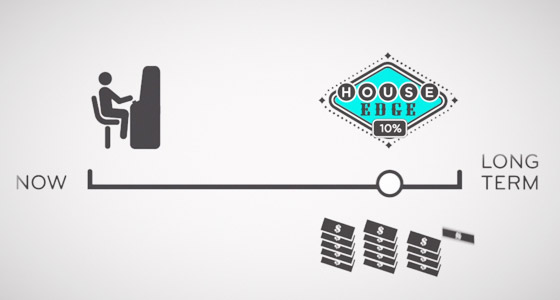
The house edge is the mathematical advantage that gambling venues and casinos maintain over players. It represents the percentage of each wager that the house expects to keep as profit over time. This advantage is not a matter of chance or luck—it is deliberately engineered into every game offered.
The house edge exists because casinos do not pay winning wagers according to the true mathematical odds of the game. Instead, they adjust payouts to retain a percentage of all bets. For example, in European roulette, there are 37 possible outcomes (numbers 1-36 plus zero), but the payout for betting on a single number is only 35 to 1 instead of the true odds of 36 to 1. This discrepancy creates a 2.7% house edge.
Calculating house edge involves a straightforward formula: subtract total player winnings from total bets, divide by total bets, and multiply by 100 to express as a percentage. Using European roulette as an example, if a player bets €1 on a single number with a 1/37 chance of winning, the expected value is calculated as follows: the house's expected profit is €0.027, resulting in a house edge of 2.7%.
Different casino games have dramatically different house edges, which directly affects how quickly a player's bankroll diminishes:
The relationship between house edge and Return to Player (RTP) is inverse: a 90% RTP means a 10% house edge, while a 98% RTP means a 2% house edge.
The house edge significantly impacts casino and betting industries. Casinos are designed to be profitable over the long term due to this mathematical advantage.
Understanding the house edge can help players make informed decisions about their gambling habits and choices.

A critical distinction exists between short-term gambling outcomes and long-term results. In the short term, variance and luck can produce wins or losses that deviate significantly from the house edge. If you bet $1 on red in roulette once, you either lose the entire dollar or win additional dollars—you don't get exactly 95 cents back.
However, over extended play, actual results converge toward the mathematical expectation. If all roulette players collectively wagered $1 million in a casino, the casino would expect to pay back approximately $950,000 in winnings and retain $50,000 as profit. This is not speculation or probability—it is mathematical certainty applied across large volumes of wagers.
The house edge guarantees that casinos will be profitable in the long run, regardless of short-term fluctuations. As volumes increase, the impact of luck diminishes, and mathematical reality dominates outcomes.
While no strategy can overcome the house edge entirely, understanding which games offer better odds is essential. Choosing games with lower house edges, such as blackjack (0.5%-2%) or European roulette (2.7%) over American roulette (5.26%) or slots (2%-15%), directly reduces your expected losses.
Games like blackjack offer additional value because optimal strategy can be learned and applied consistently, pushing the house edge toward its lower range. Understanding the true odds versus marketed odds helps you make informed decisions about which wagers to avoid entirely.
Effective bankroll management cannot eliminate losses but can extend your playing time and limit damage. By betting smaller percentages of your total bankroll per wager and setting loss limits, you reduce the speed at which the house edge depletes your funds. For example, in a game with a 5% house edge, a player wagering £1,000 expects to lose £50 on average, but if you wager £100 instead, expected losses drop to £5.
Casino bonuses and promotions can temporarily shift the mathematical advantage in your favor by providing free play or matched deposits. However, these always come with playthrough requirements that ultimately favor the house. Bonuses should be viewed as a way to extend playing time with reduced cost, not as a path to guaranteed profits.
Sports betting operates on a different principle than casino games, yet the house still maintains a mathematical edge. Sportsbooks incorporate a fee called "vigorish," "the vig," or "juice" into their odds. This ensures that no matter which team wins, the sportsbook profits.
For example, if a sportsbook offers odds of 1.90 for a team to win, a successful €100 bet would return €190. However, the true odds based on team strengths might be 1.85, representing a difference of approximately 2.6% in the sportsbook's favor. The sportsbook's edge is protected because bettors on both sides of the wager must account for this vigorish—the odds are mathematically calibrated to guarantee sportsbook profitability.
While sports betting differs from casino games because skill plays a role in predicting outcomes, the house edge still dominates long-term results for the vast majority of bettors. The difference between "fair odds" and actual offered odds means that even successful bettors must beat the vigorish consistently to achieve profitability. This requires not just predicting outcomes correctly, but predicting them more accurately than professional oddsmakers who set lines for a living.
The primary misconception about gambling is that consistent winning is possible through strategy, luck, or pattern recognition. In reality, the house edge creates mathematical certainty of long-term losses. As a Tabcorp spokesman noted: "It's important that people don't think that they can win, because you can't win in gambling. You can win for a little while but you can't win in the long run."
Another illusion is that understanding game mechanics or trends provides an edge. While knowledge of which games have lower house edges is valuable, it cannot reverse the fundamental mathematical advantage built into all gambling offerings.
Understanding the house edge should inform responsible gambling practices. Gambling should be viewed as entertainment with a built-in cost, similar to going to a movie or concert. The "cost" is the expected loss based on the house edge and your total wagers.
Key responsible gambling practices include:
While it is technically possible to win money through gambling in the short term, the mathematics of casino and sports betting operations ensure that long-term outcomes favor the house. The house edge—built into every game and betting market—represents the percentage of wagers that the house expects to retain as profit over time.
A player can reduce expected losses by choosing games with lower house edges, such as blackjack over slots, and by managing their bankroll effectively. However, no strategy can eliminate the house edge or guarantee profitability. The reality is that gambling is structured to eventually transfer money from players to casinos and sportsbooks through mathematics, not through chance or skill alone.
Understanding this fundamental truth is the first step toward responsible gambling. Winning money is possible in short-term play, but long-term profitability for players is mathematically improbable and should never be relied upon as a financial strategy.
Our affiliates are certified by top international bodies, ensuring the highest standards in the gambling industry.




Explore the intricate relationship between Return to Player (RTP) ratios and slot game payouts.
Analyzing betting systems and their effectiveness in roulette.
The gaming commission has introduced new regulations to ensure fair play in online casinos.
Advanced AI security systems are being implemented across major casinos to enhance player safety.
Mobile betting is on the rise, with innovations driving a more user-friendly experience.